+43 1 218 44 40
Urgent · fairSync licence offer & cease-and-desist

Received a licence offer from fairSync? Or already a cease-and-desist letter?
Don't simply pay — but don't ignore it either.

fairSync International — a trading name of Stington & Partner Legal GmbH, based in Cham, Switzerland — is currently sending out “non-binding licence offers” for music in Instagram posts, with sums in the mid four-figure range per post. Anyone who does not react, or reacts wrongly, receives a formal cease-and-desist letter as the next step. Licence offer or cease-and-desist letter: we review your letter and tell you how to react correctly.

  • Fast on business days — within 24 hours
  • Review of your licence offer or letter: €200 net flat fee
Recognised 2024 – 2026
  • TOP2026 DER STANDARD · Statista TOP Law Firm 2026 — Trademark & Unfair Competition Law
  • JUVE Ranking IP/IT 2025 — ranked: IP and copyright law JUVE Ranking IP/IT Ranked 2025 — IP, Trademark & Copyright Law
  • AI Awards 2024 — Leading Civil Litigation Lawyer of the Year, Austria AI Awards 2024 Leading Civil Litigation Lawyer of the Year — Austria

How these letters work

The letters follow a fixed pattern — and are deliberately structured differently from a classic cease-and-desist letter.

Sender and rights holder

fairSync International is a trading name of Stington & Partner Legal GmbH, based in Cham (Canton of Zug). It acts as a licence dealer for music labels — for instance for All Ways Dance Ltd, based in London — and collects the licence fees as contracting party in its own right.

What it is about

A sound recording was used in an Instagram post, typically in a Reel or video on a business profile. What is objected to is the use over a particular period — from the day of publication to the date of the letter.

The offer

What is offered is a retrospective licence covering the use so far and continued use up to a cut-off date. The price is calculated per post, the offer period is around ten days, and payment is to be made exclusively through an online portal. No cease-and-desist undertaking is demanded at this stage.

The second stage

Those who do not react now receive formal cease-and-desist letters in Germany — issued by the firm Hild & Kollegen on behalf of All Ways Dance Ltd, with injunctive demands, damages and legal fees. It is foreseeable that such letters will also reach recipients in Austria. For uses and licence claims in Austria, Austrian copyright law applies in principle, even where sender and law firm are based abroad. Abroad, the other side can in principle only assert the “damage” incurred there.

Non-binding — but not without consequences

The word “non-binding” invites two reactions: simply paying to be left in peace, or simply putting the letter aside. As a rule, both are the wrong route.

Simply pay?

We advise against it. The sums demanded are as a rule wholly excessive. Anyone who accepts the offer pays the full price for every single post — without it having been examined whether the claim exists at all and what amount is appropriate.

Simply ignore it?

The offer itself commits you to nothing. The infringement it relies on does not disappear as a result, however — and neither does the possibility that a formal cease-and-desist letter with an injunctive claim follows as the next step.

The decisive step: the cease-and-desist undertaking

What matters is removing the risk of repetition — through a cease-and-desist undertaking backed by a penalty, and that applies even where the letter does not demand one. Any later injunctive action then loses its basis. This matters because in copyright cases the injunctive claim is usually valued at an amount in dispute of €57,000 — the litigation cost risk is therefore far above the licence price offered.

Already received a cease-and-desist letter?

Then an undertaking is expressly demanded — usually in pre-drafted form, together with a payment demand and a short deadline. The enclosed undertaking is regularly drafted more widely than necessary and should never be signed unchecked. The same applies here: don't simply pay, don't ignore it — react correctly.

Our aim: the right response makes further action as unattractive as possible for the other side. Which tactic is right in your case is something we discuss with you on the basis of the specific licence offer or cease-and-desist letter.

From the first call to the right response

These letters come with short deadlines and can trigger considerable cost risks. We keep the free initial assessment clearly separate from any further legal work — that only follows if you actually instruct us after the conversation.

  1. 01

    Free initial assessment

    You call, we take the time for a short general assessment — how plausible the demand is, the rough range, how urgent action is, and what stage you are at (licence offer or cease-and-desist letter).

    The initial assessment is free and without obligation. Only then do you decide how to proceed.

  2. 02

    Review of the licence offer or letter — €200 net

    We go through the specific letter in detail, discuss it with you and set out your options along with the opportunities and risks. After that you know where you stand — and can decide at your leisure whether we should act for you.

  3. 03

    Cease-and-desist undertaking & strategy

    In many cases an undertaking backed by a penalty is the decisive step, even where none is demanded: it removes the risk of repetition. In parallel we settle on the best strategic response to the payment demand — matched to your actual scope of use and your appetite for risk.

  4. 04

    Out-of-court solution — and, if necessary, court

    The aim is to settle the matter quickly, as cost-effectively as possible and out of court. If a claim has already been served, or the other side turns to the courts, we represent you with decades of litigation experience — through every instance if need be.

Transparent fees — realistic expectations

We don't promise outcomes — that would not be serious. What we can tell you: we keep costs comprehensible from the outset, and the entry point is deliberately low so that nobody reacts wrongly out of worry about legal fees.

Initial assessment by phone

Free of charge. A short general assessment on the phone costs nothing. You will learn whether — and how urgently — action is needed.

Review of your licence offer or letter

Flat fee of €200 net. We go through the specific letter in detail, discuss it with you and set out your options along with the opportunities and risks. After that you decide at your leisure whether we should act for you.

Acting on your behalf

Hourly rate €380 net. If you then instruct us, in our experience around two hours is often sufficient. That covers settling the strategy, drafting the cease-and-desist undertaking and the response to the other side. If a claim has already been served, the effort depends on the proceedings.

To put that in context

Measured against licence demands per post and an injunctive claim valued at €57,000, that is a manageable investment — and the point at which the course is set.

Music cease-and-desist letters on social media — the overview

fairSync is not the only sender of such letters. You'll find the broader picture here: Music cease-and-desist letters on social media. There is a separate page on the current wave concerning a single track: “Sunny Bossa”.

Two specialised attorneys. One phone number.

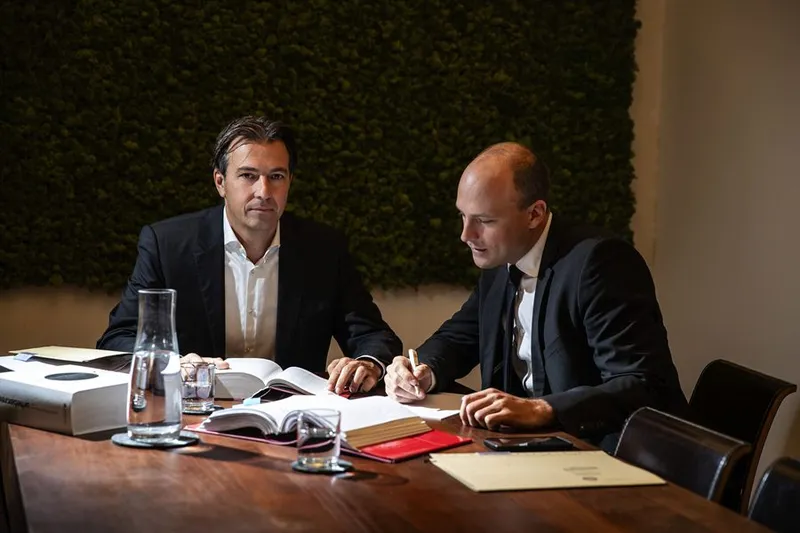
Dr. Bernhard Tonninger and Mag. Dr. Markus Albrecht working on a shared mandate
Your contacts

Dr. Bernhard Tonninger

Attorney-at-Law · Partner

Over two decades of practical copyright experience. Co-author of the Manz comprehensive commentary urheber.recht (3rd ed. 2023, sections 3, 73–75, 85 and 90 UrhG); regular annotations on Supreme Court decisions in ecolex and ÖBl. Regular representation in copyright matters out of court and in court.

Mag. Dr. Markus Albrecht

Attorney-at-Law · Partner

Partner with focus on trademark, unfair-competition and copyright law. Co-author of the Manz comprehensive commentary urheber.recht (3rd ed. 2023, sections 66–72 UrhG); regular contributions on copyright matters. Strong focus on copyright cease-and-desist letters and copyright contracts. Regular representation in copyright matters out of court and in court.

In day-to-day advisory work both partners are your contacts; in complex and larger proceedings we combine forces. Even during holiday periods, someone in the firm who knows your case is always reachable.

What clients ask about the fairSync letters

Who is behind fairSync?
fairSync International is a trading name of Stington & Partner Legal GmbH, based in Cham, Switzerland. It acts as a licence dealer for music labels — in the cases we have seen, for All Ways Dance Ltd in London — and offers retrospective licences for uses that have already taken place. Whether the claim is justified in your case, and in what amount, is what we examine on the basis of the specific letter.
The letter says it is “non-binding” — can't I simply ignore it?
The offer itself does not commit you to anything. The underlying use remains, however, and with it the risk that a formal cease-and-desist letter follows as the next step — in Germany that is already being done by the firm Hild & Kollegen. Simply setting the letter aside is therefore usually not the best solution.
Should I accept the offer and pay?
We advise against it. The sums demanded are as a rule wholly excessive, and they are charged separately for every single post. Before you pay, it should be established whether the claim exists at all and what amount would be appropriate.
Why give a cease-and-desist undertaking when none is being demanded?
Because it is the decisive protection against the second stage. A cease-and-desist undertaking backed by a penalty removes the risk of repetition — which deprives any later injunctive action of its basis. That matters because in copyright matters the injunctive claim is usually valued at an amount in dispute of €57,000. It does have to be drafted correctly: no wider than necessary, but wide enough actually to remove the risk of repetition.
How high are the sums demanded?
In the cases before us and brought to us, fairSync demands between €4,800 and €11,000 net per Instagram post for its licence offers. In our view that is excessive in these cases. Here too, what matters is reacting correctly. If the same track was used in several posts, a separate offer follows for each post and the amounts add up accordingly. In our assessment these sums are as a rule wholly excessive.
What does advice from Tonninger Schermaier & Partner cost?
We work in three stages. A short general assessment by phone is free of charge. For the actual review of your licence offer or cease-and-desist letter — we go through the letter in detail, discuss it with you and set out your options — we charge a flat fee of €200 net. Only if you then instruct us to act on your behalf does our hourly rate of €380 net apply; in our experience, around two hours is often sufficient. This keeps you in control of the costs at every step.
I have already received a cease-and-desist letter — what now?
Then deadlines matter. A cease-and-desist letter — in Germany currently from the firm Hild & Kollegen — regularly demands a cease-and-desist undertaking and a payment within a short period. The enclosed undertaking is usually drafted more widely than necessary; do not sign it unchecked. We review a cease-and-desist letter for the same flat fee of €200 net. If a claim has already been served, missing a deadline risks a default judgment and the full amount plus the other side's legal and court costs. Please call immediately and have the letter and the date of service to hand.

Read on: Music cease-and-desist — overview · Copyright cease-and-desist letter

Licence offer or cease-and-desist letter from fairSync?

We examine whether the claim is justified and, above all, whether the amount is appropriate — and we tell you how to react. On business days we react quickly, within 24 hours at the latest. Directly with Dr. Tonninger or Dr. Albrecht.

Call Email